Devpost
Participate in our public hackathons
Devpost for Teams
Access your company's private hackathons
Grow your developer ecosystem and promote your platform
Drive innovation, collaboration, and retention within your organization
By use case
Blog
Insights into hackathon planning and participation
Customer stories
Inspiration from peers and other industry leaders
Planning guides
Best practices for planning online and in-person hackathons
Webinars & events
Upcoming events and on-demand recordings
Help desk
Common questions and support documentation
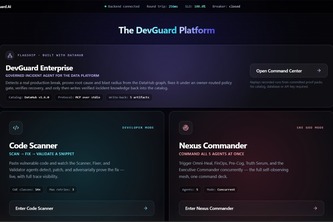
Autonomous data incident repair, with proof!
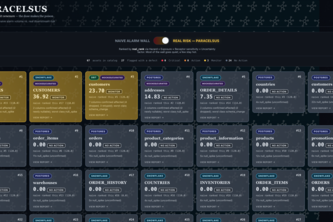
Data tools rank problems by how broken something is. Paracelsus ranks them by how much harm can actually reach someone, then writes the verdict back into DataHub. The dose makes the poison.
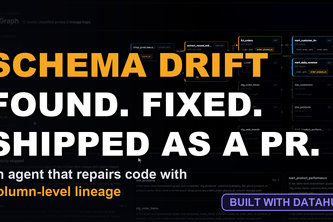
When an upstream column is renamed, retyped or dropped, this agent uses DataHub's column-level lineage to find exactly what breaks, repairs the code, and ships the fix as a reviewed pull request.
The on-call agent that gets cheaper every time it runs: it files each postmortem inside DataHub, so the next incident starts from the last one. Measured: 20 tool calls cold, 15 warm.
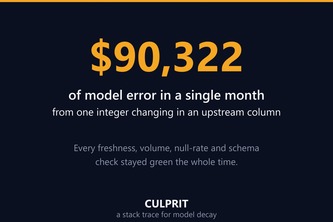
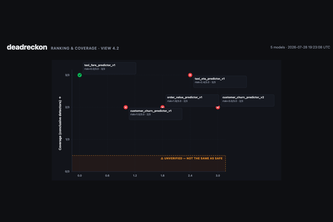
A stack trace for model decay. Give it a degraded model and a vague complaint, and it walks DataHub's ML lineage to the column that broke it, prices the damage in dollars, and opens the PR.
Every data change ships with proof, not confidence. ContextSeal uses DataHub context to block risky schema changes and generate safe, reviewable migration packages.
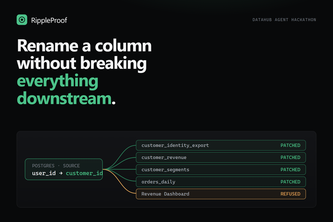
Renames a warehouse column without breaking what depends on it: reads DataHub lineage, writes dbt repairs across every affected repo, proves they build, and refuses when it cannot prove them safe.
ML Guard is a production ML agent that uses DataHub’s context graph to detect target leakage and stale-model risk, trace every finding through column lineage, and write evidence back to DataHub.
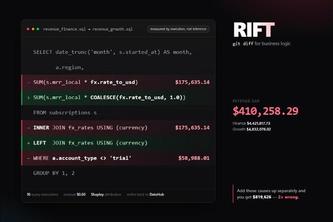
Two dashboards disagree about revenue. RIFT proves exactly why it rewrites the SQL, executes it, and measures what each clause is worth in dollars — then writes the answer back to DataHub.
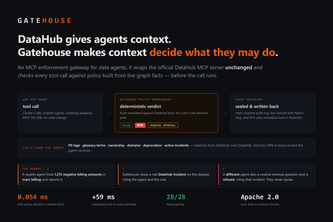
DataHub gives agents context. Gatehouse makes context decide what they may do: an MCP gateway that checks every agent tool call against live graph facts before it runs.
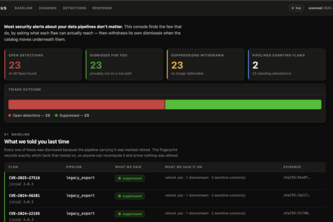
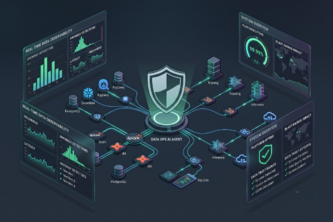
Most security alerts about your data pipelines don't matter. This tells you which five out of a thousand do
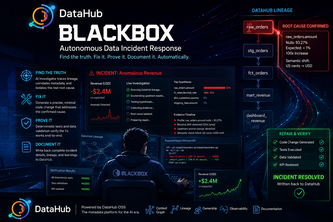
A closed-loop incident agent for DataHub: proves root cause from the lineage graph, refuses when the evidence is insufficient, and writes verified incident knowledge back as first-class metadata.
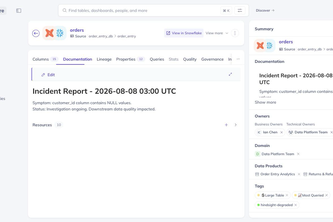
The organizational memory engine for DataHub: an agent that investigates data incidents, proves the root cause with evidence, and turns every resolution into reusable knowledge.
An agent that reads your DataHub catalog every day, writes what it found in four voices people actually read, and writes it back so the next person inherits it.
An agent that walks DataHub's ML lineage graph to catch silent model failures - and tells you, separately, what it couldn't check at all.
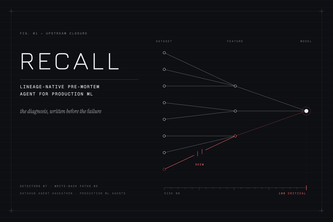
A lineage native pre-mortem agent for production ML which reads DataHub's causal graph backwards to find the models that are about to break, and writes the diagnosis back into DataHub.
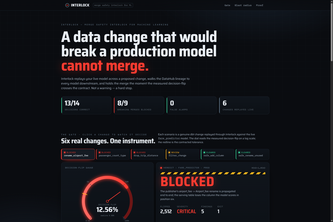
A pull-request gate that blocks the data change which would silently break your production ML model — it walks DataHub lineage and replays the real model to prove it.
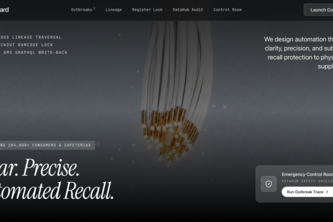
An autonomous DataHub agent that traces food recalls across supply chain tiers, protecting consumers before bad food leaves store shelves.
OmniSRE turns DataHub into an autonomous SRE control plane—detecting silent data & ML failures, tracing graph blast radius, and executing reversible self-healing fixes.
The courthouse for AI agents on DataHub: register identity, gate MCP writes, cross-examine catalog vs SQL, propose changes, write verdicts to GMS so the next agent inherits.
Prevent data disasters before they happen. ChangePilot maps the blast radius of data changes and autonomously generates the fixes.
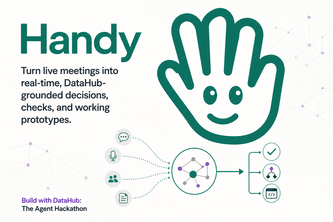
Turn live meetings into real-time, DataHub-grounded decisions, checks, and working prototypes.
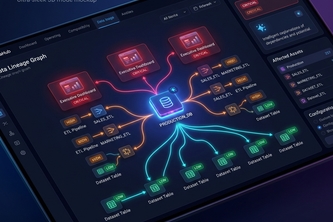
AI-powered tool that tells you exactly what dashboards, pipelines, and tables will break before you change a database schema — using DataHub's lineage graph to prevent data disasters.
Turns DataHub-shaped metadata into governed, bounded, deterministic work packets for human review.
1 – 24 of 612