Devpost
Participate in our public hackathons
Devpost for Teams
Access your company's private hackathons
Grow your developer ecosystem and promote your platform
Drive innovation, collaboration, and retention within your organization
By use case
Blog
Insights into hackathon planning and participation
Customer stories
Inspiration from peers and other industry leaders
Planning guides
Best practices for planning online and in-person hackathons
Webinars & events
Upcoming events and on-demand recordings
Help desk
Common questions and support documentation
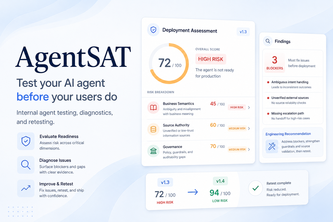
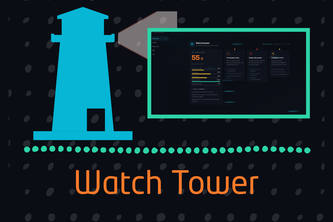
An internal benchmark that tests whether AI agents are actually ready for your company.
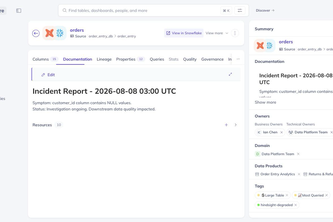
The on-call agent that gets cheaper every time it runs: it files each postmortem inside DataHub, so the next incident starts from the last one. Measured: 20 tool calls cold, 15 warm.
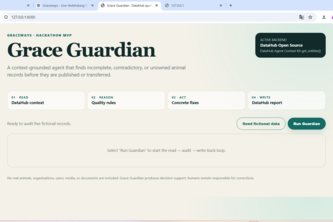
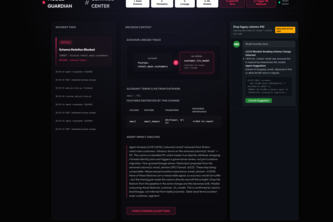
Grace Guardian, an open-source project, audits animal records in DataHub, detects missing or conflicting information, and writes actionable, traceable quality reports back to DataHub.
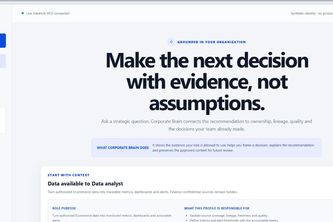
Turn governed company metadata into decisions people can verify, approve, and remember.
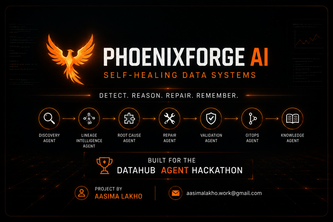
Self-healing data pipelines: AI agents that diagnose, fix, and document incidents using DataHub's MCP Server.
Marg maps UK immigration rules as a dependency graph in DataHub, so students see what one changed date breaks downstream. Every rule is cited to gov.uk, and it refuses to guess.
The DataHub immune system for data incidents: contain what is exposed, release what is proven, prevent what is remembered.
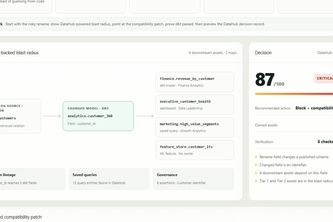
A DataHub-grounded agent that reviews risky data changes, generates safe patches, verifies them, and writes decisions back.
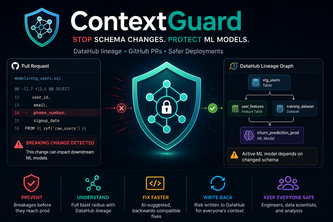
ContextGuard uses DataHub lineage to detect schema changes that threaten ML models, block risky PRs, and suggest safe fixes.
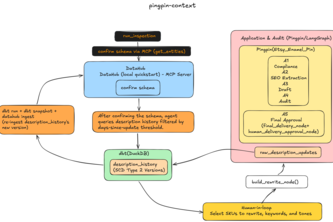
An agent that reads DataHub via MCP, confirms real schema, flags stale Etsy listings, gets human approval, rewrites via a real multi-agent pipeline, then writes results back — closing the loop.
Attack surface mapping, powered by DataHub.
Blocks schema changes that break ML models. It asks DataHub which feature dies with the column, how much the model actually used it, and turns that answer into a failing CI check.
An AI Data Engineering Copilot that uses DataHub metadata, lineage, RAG, and MCP tools to analyze data impact and generate production-ready dbt, Airflow, and SQL assets.
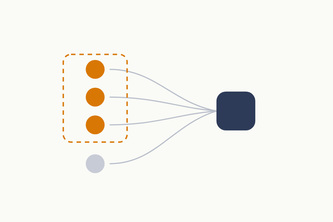
How many upstream feeds must break at once before your model notices? Sentinel Mesh computes that number from DataHub lineage, monitors it over time, and writes it back to the catalog.
DataPilot is an AI-powered data engineering platform that autonomously investigates pipeline failures, traces data lineage, and generates production-ready code fixes
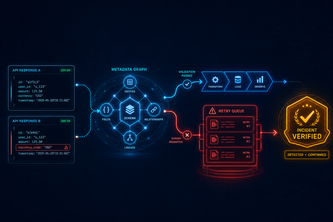
HTTP 200 can hide a broken business path. This agent uses DataHub schema and lineage to find the risky workflow, prove the route changed, and write verified evidence back to the affected asset.
Plan Your Meals, Simplify Your Cooking!
MetaGate turns DataHub metadata into an allow-or-block decision before an AI agent acts.
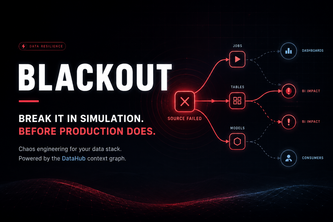
Chaos engineering for your data stack. BLACKOUT uses DataHub to simulate failures before production, map blast radius, find structural SPOFs, and turn every test into resilience memory.
Axiomatic Intelligence for data incidents: DataHub-powered agents prove which branch is unsafe and preserve what can safely keep running.
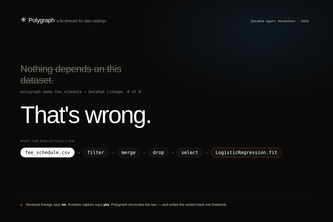
A lie detector for data catalogs. Polygraph runs your pipeline, catches the lineage DataHub got wrong, and writes the verdicts back, where people and agents actually look.
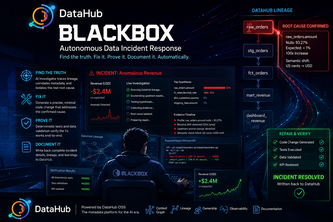
Autonomous data incident repair, with proof!
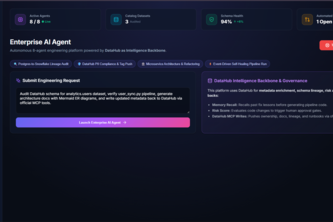
An autonomous 8-agent engineering fleet using DataHub as an Intelligence Backbone to audit repos, detect schema drift, patch SQL, and write back enriched metadata via MCP.
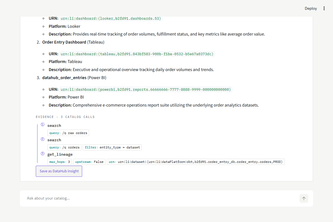
An agent that answers hard questions about your DataHub catalog - lineage, ownership, PII, blast radius - shows every catalog call behind the answer, and writes what it learned back into DataHub.
457 – 480 of 612